|
|
|
|
|
|
||
Sound Card
Quality built-in sound support has become fairly commonplace in the motherboards of today. Even so, there are still advantages to an add-on sound card. Even better sound, of course, but also better overall performance out of the computer since the sound card is there to handle audio processing. On a heavily loaded system that makes ample use of sound, an add-on sound card can improve performance from 5 to 15 percent.
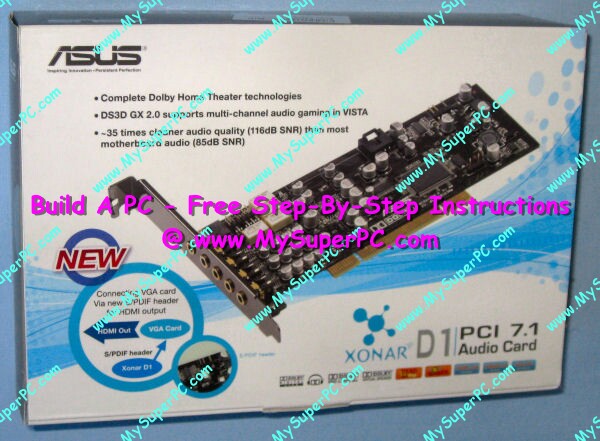
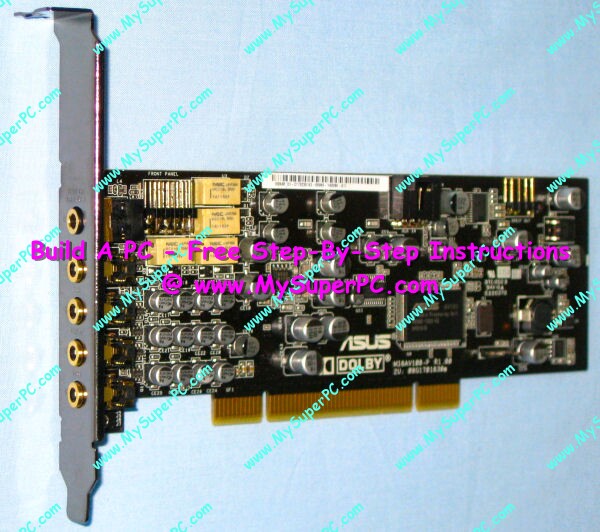
Click on either picture to see it enlarged.
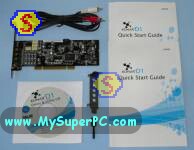
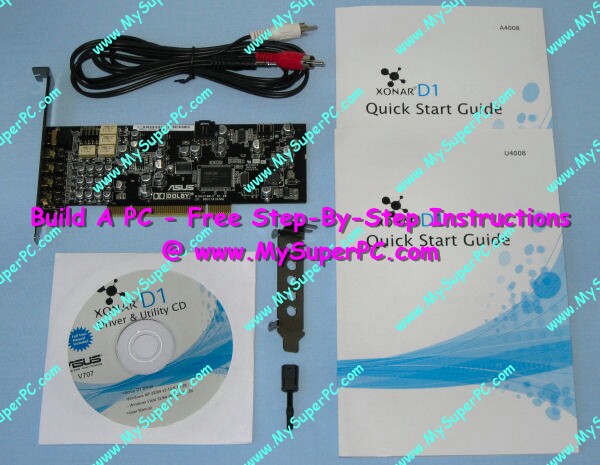
Here's everything that comes in the ASUS Xonar D1 retail box with the sound card removed from its protective anti-static bag.
Click on the picture to see it enlarged.
For the best sound possible you'll still need a sound card like the ASUS Xonar D1, as well as speakers that let it live up to its full potential. Some would want the extra performance it would give the system since that extra performance would come when it's needed most, namely when the computer is at its busiest simultaneously producing a wide variety of graphical effects, sound effects, speech and music. On the other hand, I used My Super PC extensively without an add-on sound card for a long time and performance never seemed an issue.
The particular model I'm using, the ASUS Xonar D1, fits into a PCI slot on the motherboard. The ASUS Xonar DX model is essetially the same sound card, but use a PCI-E slot on the motherboard, and also uses a power connector from the power supply.
For many years, Creative was king of the sound cards. They were the ones who pushed the envelope the quickest and the best. They come up with technical improvements, like EAX, which enhances the Microsoft DirectSound interface to provide better sound effects, such as the type of echoing you would hear in a cave. They were the first to provide 24-bit sound (instead of 16-bit sound), which improves sound quality just as 24-bit color images look better than 16-bit color images. And they were the first to meet THX certification with a sound card. Their Sound Blaster X-Fi model was very popular.
Today, most reviewers give the edge in sound quality to the ASUS Xonar D1/DX over the Sound Blaster X-FI models.
An ASUS Xonar D1 definitely sounds better than motherboard onboard sound. Richer, clearer, more detail - just better. But that doesn't mean onboard sound built into the motherboard is unacceptable by any means.Speakers
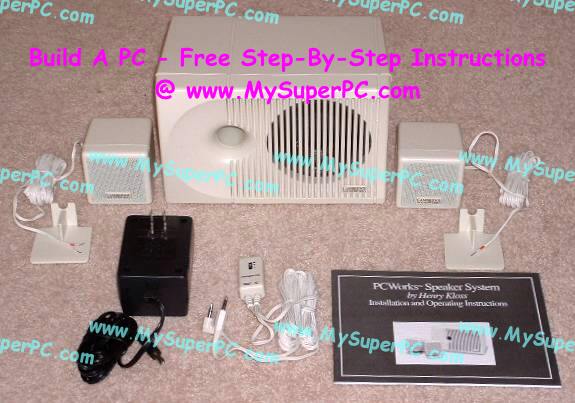
For speakers, you should definitely get at least a high-quality 3-piece speaker system (sub-woofer with 2 satellite speakers). The difference in sound quality over a 2-speaker system is startling. I heartily recommend the Cambridge SoundWorks PCWorks speakers that I have in My Super PC. And they are not expensive at all.
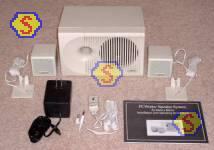
The Cambridge SoundWorks PCWorks speakers are described as 2.1 speakers since they have two satellites plus the sub-woofer. Speakers can also be found with more satellites, such as 4.1, 5.1 and even 7.1. The problem with so many speakers is that it becomes problematical to arrange them effectively. It's quite easy to arrange the two, small satellite speakers of the Cambridge SoundWorks PCWorks so that they are optimally placed equidistant from the listener. Mine flank the monitor. But it's not so easy to do with four or more satellite speakers.
The idea with so many satellites is to not only improve the quality and detail of the sound, but to also let you hear from which direction the sound is coming - behind you, to your left, or even above you - which is especially useful in games. For example, many games have the user playing in first-person mode as a character in the game so that what's shown on the screen is what your character sees. Effects such as hearing water running underneath a bridge while your character walks over the bridge, hearing an airplane dive at you, or hearing footsteps run up behind you are fantastic game experiences. But accomplishing this with speakers is impractical for nearly everyone. Not only is the cost of the speakers a factor, but a lot of room space is required, perhaps to even place speakers on waist-high stands surrounding the computer user. And how many of us enjoy the luxury of being able to turn up the PC volume to whatever level we like whenever we like? No, this solution is all wrong.Headphones
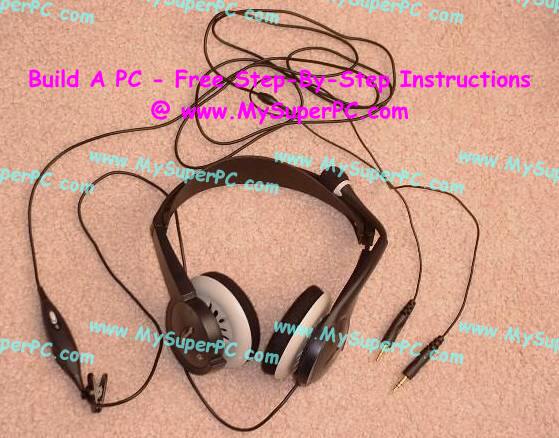
The right way to go is with quality headphones. Quality headphones accomplish all of this. They allow you to hear high quality sound. They allow you to hear more sound detail including subtle sounds. They provide complete directional information of the sound, including above, below and behind. They don't bother anyone else who may be around, regardless of the volume level. And they do this for much less cost than a comparable speaker system. The Plantronics Audio 90 headphones I use do a remarkable job.
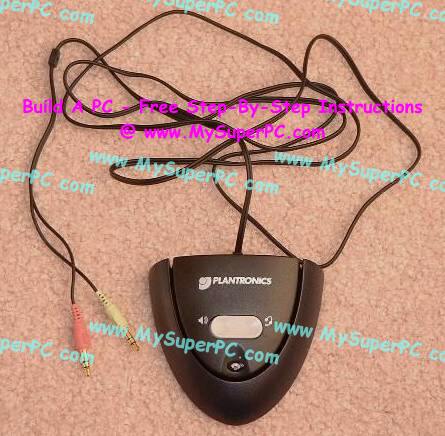
Some may even decide not to use speakers at all, just good headphones. I must say I use my headphones a lot more than my speakers. But there are occasions when speakers are needed, so I have both. To make it easy to switch between them, I use a Headset Switch. Just by flipping a switch the sound is routed to either the speakers or to the headphones.
Here are pictures of these two components. I describe my computer headphones and headswitch further on this page
Plantronics Audio 90 Headphones Plantronics PC Speaker Headset Switch 

My complete recommendations for building a computer with quality components at unbeatable prices is on my home page at Build A Computer Like My Super PC - Cost To Build A Computer. Here again are the recommendations for a sound card!
|