My Super PC

Build A PC - How To Assemble

Computer Assembly - How To Assemble A PC

Install Windows XP On A SATA Hard Drive

The operating system of choice is Windows XP due to its compatibility with the latest in hardware. The Windows XP Home Edition Upgrade requires you have a previous copy of Windows 98 or better that can be used for verification. The version I'm using comes with Service Pack 2 (and therefore also Service Pack 1) already built-in.
How To Assemble A Computer - PC Assembly Guide, Windows XP Retail Box
Motherboards like the MSI K8N Neo Platinum that support SATA hard drive should come with a floppy disk that contains the SATA drivers. This floppy disk is needed at this time since the nForce3 SATA RAID Driver is installed during the Windows XP Setup. The floppy disk that comes with the MSI K8N Neo Platinum motherboard is labeled "nforce3 SATA RAID Driver".
How To Assemble A Computer - PC Assembly Guide, Floppy Disk with the nForce3 SATA RAID Driver for MSI K8N Neo Platinum Motherboard
Or the nForce3 SATA RAID driver can be downloaded from the motherboard manufacturer's download support page.
How To Assemble A Computer - PC Assembly Guide, Download for nForce3 SATA RAID Driver for MSI K8N Neo Platinum Motherboard
At this point the computer is sitting from having quit the Data Lifeguard Diagnostic utility waiting for the computer to be rebooted. When we reboot the computer, we need to enter the BIOS so that we can change the boot device to be the CDROM. Press the reset button on the computer to get it to reboot. Enter the CMOS Utility Menu by using the "Delete" key after the single beep is emitted and the BIOS header screen appears. Navigate to the menu containing the First Boot Device, Second Boot Device and Third Boot Device and change the settings for each of them to CDROM. In a moment, we'll save these changes and exit the BIOS. But first, insert the Windows XP Home Edition Upgrade CDROM into the CD drive. Now press F10 to save the changes and exit the BIOS. The computer will reset. Let it proceed and it will access and boot from the CD drive. You may get a prompt that says "Boot From CD" or "Press return to boot from CD", or both. You can press the Enter key when you see the prompt, but the computer will boot from the CD regardless.
How To Assemble A Computer - PC Assembly Guide, SATA Hard Drive Windows XP Install
This "Windows Setup" screen as shown below appears briefly. It lasts for around 10 seconds or so. Notice at the bottom of the screen it says "Press F6 if you need to install a third party SCSI or RAID driver...". Since the hard drive in the computer is a SATA hard drive, press F6. Just press and release it as you would any keyboard entry. No need to hold it down or press it a bunch of times. What's kind of deceiving is that there's no positive feedback when you press F6. You might expect the screen to say "ok" or immediately move on to the next step since F6 was pressed and there's no point waiting anymore. But no, it just sits there for the full timeout before moving on. And when the install does continue, it appears to just carry on normally as if you had not pressed the F6 key. But after a minute or so, something different does happen.
How To Assemble A Computer - PC Assembly Guide, SATA Hard Drive Windows XP Install
Here's the something different. Windows prompts you for the mass storage adapter, which is the driver for the SATA hard drive. Press the "s" key to "Specify Additional Device". Lower-case "s" is fine.
How To Assemble A Computer - PC Assembly Guide, SATA Hard Drive Windows XP Install
Windows XP setup prompts for the SATA hard drive driver, the "hardware support disk" so to speak. Insert the nForce3 SATA RAID driver floppy into the floppy drive and hit the "Enter" key.
How To Assemble A Computer - PC Assembly Guide, SATA Hard Drive Windows XP Install
Windows XP setup accesses the floppy drive and comes back with this list of "SCSI Adapters". It's confusing that Windows XP is referring to "SCSI Adapters" when what's really being dealt with here is the driver for the SATA hard drive. SCSI is even a parallel interface. Both of the listed adapters need to be loaded, but scroll down to select the "NVIDIA NForce Storage Controller" first. Press the "Enter" key. Windows XP setup accesses the floppy drive and loads the driver.
How To Assemble A Computer - PC Assembly Guide, SATA Hard Drive Windows XP Install
And Windows XP Setup prompts again for the mass storage adapter. Again press the "s" key to "Specify Additional Device".
How To Assemble A Computer - PC Assembly Guide, SATA Hard Drive Windows XP Install
And Windows XP Setup prompts again to have the floppy disk inserted that contains the SATA hard drive driver. It should still be in the floppy drive, so just press the "Enter" key.
How To Assemble A Computer - PC Assembly Guide, SATA Hard Drive Windows XP Install
This time leave the selection on "NVIDIA RAID CLASS DRIVER". This driver should be loaded even if your computer is not going to be used with RAID. Press the "Enter" key. Windows XP setup accesses the floppy drive and loads the driver.
How To Assemble A Computer - PC Assembly Guide, SATA Hard Drive Windows XP Install
Once more back again at the Windows XP setup prompt for the mass storage adapter. This time hit the "Enter" key to have Windows XP Setup continue. Leave the nForce3 SATA RAID Driver floppy disk in the floppy drive. Windows XP Setup accesses it again later during the setup.
How To Assemble A Computer - PC Assembly Guide, SATA Hard Drive Windows XP Install
Windows XP setup continues for about a minute while generic driver installation is performed. After this, here is the first screen you get for the Windows XP Home Edition Upgrade install. When you get to this screen, press the "Enter" key.
How To Assemble A Computer - PC Assembly Guide, SATA Hard Drive Windows XP Install
When you're ready, press the "F8" key to accept the Windows Licensing Agreement.
How To Assemble A Computer - PC Assembly Guide, SATA Hard Drive Windows XP Install
Windows XP now verifies you have a previous copy of Windows 98 or better. Remove the Windows XP CD and insert the CD for your previous copy of Windows into the CD-ROM drive. Then press "Enter".
How To Assemble A Computer - PC Assembly Guide, SATA Hard Drive Windows XP Install
Windows XP will partition and format the hard drive as part of the install. This is very handy and is much easier than dealing with FDISK. Follow the on screen prompts to create the partitions you desire. Whether or not you even want partitions is entirely up to you. Some prefer just one big partition and that will work. Here are the partitions I made for my own hard drive and how I plan to use them.
  1. The first partition, C:, is the biggest at 1100GB. I like to put all the executables on C: so I made this a large partition. Programs generally expect to be loaded onto C:. Usually they do just fine on another drive, but occasionally I've run into a difficulty. Putting them on C: ensures there will be no problem. I made C: large because I have a number of games and edutainment packages on the PC, and they can take vast amounts of drive space.
  2. The next partition is 60GB and is used for MP3 music files and videos.
  3. The next partition is 30GB and is used to keep a permanent backup copy of any programs or patches I download to install.
  4. The next partition is 20GB and is used to hold the GoBack disk restoral history buffer. Note: GoBack 4.0 supports a history buffer up to 8GB in size. But for some reason, it does not allow the history buffer to be more than about half of the total partition size. This means that if you want the history buffer in its own partition and you want to be able to set it to the maximum size then the partition should be about 20GB in size.
  5. The next partition is 10GB and is spare.
  6. The next partition is 6GB and is used to hold my own development programs. That way if they run amok then they'll only gobble up this much hard drive space before crashing rather than the entire hard drive.
  7. The last partition is about 2.5GB and is used to hold the Temporary Internet Files for Internet Explorer.
How To Assemble A Computer - PC Assembly Guide, SATA Hard Drive Windows XP Install
After creating the partitions the way you like, highlight the first entry and press the "Enter" key.
How To Assemble A Computer - PC Assembly Guide, SATA Hard Drive Windows XP Install
Windows XP will now format the C: partition. It's best to do the thorough format on the drive, not the "Quick" option.
How To Assemble A Computer - PC Assembly Guide, SATA Hard Drive Windows XP Install
You'll be prompted to return the Windows XP Home Edition Upgrade CD to the CDROM drive before the formatting begins.
How To Assemble A Computer - PC Assembly Guide, SATA Hard Drive Windows XP Install
Formatting my SATA Western Digital Caviar SE 200GB hard drive took about 40 minutes.
How To Assemble A Computer - PC Assembly Guide, SATA Hard Drive Windows XP Install
Windows then takes a few minutes to copy files over to the hard drive. If you removed the floppy containing the nForce3 SATA RAID Driver from the floppy drive then Windows XP Setup prompts you for it here as the first step before copying.
How To Assemble A Computer - PC Assembly Guide, SATA Hard Drive Windows XP Install
Windows XP Setup then reboots the computer.
How To Assemble A Computer - PC Assembly Guide, SATA Hard Drive Windows XP Install
After re-booting, Windows XP begins to install on the C: drive.
How To Assemble A Computer - PC Assembly Guide, SATA Hard Drive Windows XP Install
I didn't make any changes at the "Regional and Language Options" page, I just clicked on "Next".
How To Assemble A Computer - PC Assembly Guide, SATA Hard Drive Windows XP Install
Enter the "Name" and "Organization" for the computer. Then click "Next".
How To Assemble A Computer - PC Assembly Guide, SATA Hard Drive Windows XP Install
Enter the "Product Key" for your copy of Windows XP which can be found as directed on the screen. Then click "Next".
How To Assemble A Computer - PC Assembly Guide, SATA Hard Drive Windows XP Install
Enter a name for your computer. Then click "Next".
How To Assemble A Computer - PC Assembly Guide, SATA Hard Drive Windows XP Install
Select your Time Zone. Then click "Next".
How To Assemble A Computer - PC Assembly Guide, SATA Hard Drive Windows XP Install
For Network Settings, I used the default of "Typical settings".
How To Assemble A Computer - PC Assembly Guide, SATA Hard Drive Windows XP Install
Windows XP is off again to do some more installing for a while.
How To Assemble A Computer - PC Assembly Guide, SATA Hard Drive Windows XP Install
Click the "Next" button when this "Welcome..." window appears.
How To Assemble A Computer - PC Assembly Guide, SATA Hard Drive Windows XP Install
I chose "Not Right Now" on this window offering to turn on Automatic Updates since the modem isn't even installed yet. Then clicked the "Next" button.
How To Assemble A Computer - PC Assembly Guide, SATA Hard Drive Windows XP Install
I entered my name as the only user and clicked on the "Next" button.
How To Assemble A Computer - PC Assembly Guide, SATA Hard Drive Windows XP Install
Click the "Next" button on the "Thank you" window and...
How To Assemble A Computer - PC Assembly Guide, SATA Hard Drive Windows XP Install
...you're there!! Just before this screen, you might get a notification box indicating that windows has automatically adjusted your screen resolution.
How To Assemble A Computer - PC Assembly Guide, SATA Hard Drive Windows XP Install
Wow! How cool is this? To have a pristine computer at your fingertips. Here we sit with Windows XP installed on the hard drive and nothing else. Kind of creepy to be looking at so much empty. And a bit scary, too. Up until now we've been dealing with mostly hardware. Windows XP was the first software to be installed. The only hardware left to be installed is the modem and sound card, but we've only just started installing the software.

Any Windows XP Service Packs that have not yet been installed should be installed now. Since the Windows XP version I'm using includes Service Pack 2 (and therefore also Service Pack 1), I have everything at this point. Here is a link to Windows XP Service Pack 2. Another way to get these updates is to let them come in through the Windows XP Automatic Update procedure. This is fine, it just takes longer due to downloads and restarts.

To get a first look at your devices as you'll be seeing them for the most part from here on out, click on Start -> My Computer, which brings up something like this. Notice, I've circled in blue the "View system information" since that will be used in a moment.
How To Assemble A Computer - PC Assembly Guide, SATA Hard Drive Windows XP Install


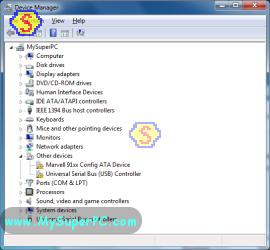
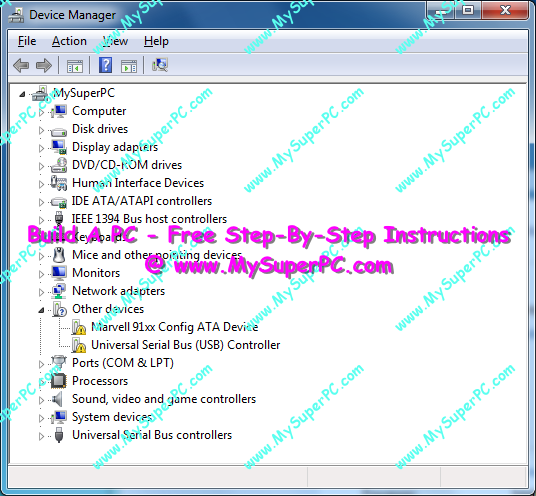
One important thing to do after installing Windows XP or installing any new hardware is to look at the Device Manager to see if there are any problems. Sure enough, I see a number of big yellow question marks and exclamation points in the device list. To see the Device Manager settings from here, click on "View system information", which brings up the System Properties window, then click the Device Manager button on the Hardware tab. Here's what I see. I've expanded the entry for the IDE ATA/ATAPI controllers to have a look at the SATA controller.
How To Assemble A Computer - PC Assembly Guide, SATA Hard Drive Windows XP Install


You might notice that the computer seems to be rather sluggish. Moving the mouse, navigating the Windows XP menus, moving windows around, and so forth - just sluggish. And it may be that the windows and text displayed on the screen are not clean and crisp and not the right resolution. Checking the monitor under Display Properties shows it's being recognized as a generic plug-and-play monitor rather than as a Dell 2001FP monitor. To check this right-click on the desktop and select "Properties" from the pop-up menu. The "Display Properties" window appears as shown in the first picture. On the "Settings" tab, click on the "Advanced" button as shown in the second picture. The "Plug and Play Monitor" window appears as shown in the third picture. Click on the "Plug and Play Monitor" tab to see that Monitor Type is set to "Plug and Play Monitor" as shown in the fourth picture.
How To Assemble A Computer - PC Assembly Guide, Display Properties How To Assemble A Computer - PC Assembly Guide, Display Properties How To Assemble A Computer - PC Assembly Guide, Display Properties How To Assemble A Computer - PC Assembly Guide, Display Properties


All of these problems will get resolved once the drivers are loaded, such as the drivers for the motherboard, monitor and video card.

Remove the Windows XP Home Edition Upgrade CD from the CD-ROM. Remove the nForce3 SATA RAID Driver floppy from the floppy drive.

Don't forget to change the BIOS settings for First Boot Device, Second Boot Device and Third Boot Device back to what you want (I use the hard drive for all three). Shut the computer down. Turn the computer back on, enter the BIOS, and update the boot device settings. Save the BIOS settings and allow the computer to boot to the desktop. Re-booting now, after the install, will also ensure you don't get the RPC Server Is Unavailable error message.

Be aware that all the other hard drive partitions except C: are still "Raw" because they have not yet been formatted. To format a hard drive partition, click Start and then My Computer to see all of your logical hard drives. To format a logical hard drive, right-click on it and then select Format from the pop-up window. Now is a good time to do the formatting since GoBack will be installed pretty soon and I don't think there's any point in having GoBack enabled for formatting.

I recommend to turn off the Windows screen saver function. Typically the Windows screen saver kicks in after a user defined time period of "inactivity". It's my experience that the screen saver causes problems with other applications. It can be difficult to actually trace the problem to the screen saver since you tend to forget it's even running. In addition, there's no way to predict what it's going to consider "inactivity" and therefore when or even whether it will activate in the middle of whatever else is going on. It has no practical purpose any longer since monitor screen burn in is not a problem with today's monitors. To turn off the screen saver function, right-click on the Desktop, click on Properties in the pop-up menu, select the Screen Saver tab, and for the Screen Saver select "(None)".

Common Problems

If there is no standard IDE (PATA) hard drive in the computer but the IDE channel has not been disabled in the BIOS, then Windows XP will fail to install saying that setup could not find the hard drive.

Many of the problems I've seen during the actual Windows XP install were due to the BIOS settings. The Windows XP install takes 30 to 45 minutes. During this time the computer is doing an extensive amount of processing and disk input/output. If the Windows XP install completes successfully then you can have some confidence that your BIOS settings are good. Here are the problems I've seen due to improper BIOS settings:
  • The install hangs-up (the computer freezes).
  • An error message that says something like "Windows has detected a problem with your computer. This could be caused by bad drivers". That may not be the exact text of the message, but it's the gist of it, anyway.


  • If, after installing Windows XP and all the service packs, you still have a USB device conflict like the one circled in blue below then it can be cleared up by following the steps given by Microsoft Support 329632 Availability of USB 2.0 Support in Windows XP Service Pack 1.
    How To Assemble A Computer - PC Assembly Guide, Microsoft Support 329632 Availability of USB 2.0 Support in Windows XP Service Pack 1
    I've also captured the steps here:
    How To Assemble A Computer - PC Assembly Guide, Microsoft Support 329632 Availability of USB 2.0 Support in Windows XP Service Pack 1


    My complete recommendations for building a computer with quality components at unbeatable prices is on my home page at Build A Computer Like My Super PC - Cost To Build A Computer. Here again are the recommendations for Windows!
    Description Where I Would Get It Today Today's Price Comments
    Windows XP Home Edition Upgrade
    with Service Pack 2
    Amazon
    $99.49 Free shipping! Retail box. Clicking the link takes you directly to it. The "upgrade" version requires you already have the CD from Windows 98 or better. You can do a new, clean install of Windows XP using the upgrade version, so it's not necessary to actually install Windows 98 first.
    Windows XP Home Edition
    with Service Pack 2
    Amazon
    $189.99 Free shipping! Retail box. Clicking the link takes you directly to it.
    Goback 4.0
    Amazon
    $44.99 Free shipping! Retail box. Clicking the link takes you directly to it.


    Back to My Super PC - Home Page


    How To Build A Computer. Step By Step Instructions To Assemble. Skip To Any Assembly Step.

      Parts List [go]
      Tools [go]
      Antistatic Wrist Strap [go]
      Computer Case and Power Supply [go]
      Motherboard [go]
      Processor, CPU Cooler and Thermal Compound [go]
      RAM - System Memory [go]
      Video Card [go]
      Monitor [go]
      Keyboard and Mouse [go]
      Floppy Drive [go]
      Hard Drive [go]
      CD-ROM, CD-RW, DVD RW [go]
      Sound Card and Speakers [go]
      Modem [go]
      Install the Processor onto the Motherboard [go]
      Install the CPU Cooler [go]
      Install the RAM - System Memory [go]
      Install the Motherboard into the Computer Case [go]
      Install the Video Card [go]
      Connect the Power Supply to the Motherboard [20-pin Connector  or  24-pin Connector]
      Connect the PN1 and PN2 Indicators to the Motherboard [KS-282 to EPoX 8RDA+  or  Sonata to MSI K8N Neo Platinum]
      Ready the Monitor [go]
      Ready the Keyboard and Mouse [go]
      First Boot [go]
      First Boot Common Problems [go]
      Install the CD-ROM, CD-RW, DVD RW Drives [go]
      Install the Hard Drive and Floppy Drive [PATA Hard Drive  or  SATA Hard Drive]
      Connect the Speakers (if using built-in sound) [go]
      Second Boot [PATA  or  SATA]
      Configure the BIOS Parameter Settings [EPoX 8RDA+  or  MSI K8N Neo Platinum]
      Test The Hard Drive [PATA  or  SATA]
      Install a Second SATA Hard Drive For RAID (optional) [go]
      Install the Operating System - Windows XP [on PATA hard drive  or  on SATA hard drive]
      Driver Installation [go]
      How To Copy Big Files From Another Computer Using Just a Floppy Drive [go]
      Install the Modem [go]
      Install the Motherboard Chipset Drivers [EPoX 8RDA+  or  MSI K8N Neo Platinum]
      Install the Monitor Driver [go]
      Install the Video Card Drivers [EPoX 8RDA+  or  MSI K8N Neo Platinum]
      Install the Sound Card and Speakers [go]
      Install System Information Utility - EVEREST [go]
      Diagnostic Test - DirectX [go]
      Speed Test - System Memory (RAM) Performance [go]
      Speed Test - Hard Drive Performance [PATA and SATA results]
      Speed Test - CD Performance [go]
      Speed Test - Total System Performance [go]
      Stress/Torture Tests [go]
      Connect Front Panel Ports For Audio, Firewire and USB 2.0 [go]
      Install Rear Panel Ports For Firewire And USB 2.0 [go]
      Install The Computer Case Fans [go]
      Post Assembly Needs [go]
      Graduation [go]
      Video Card Driver Settings [go]
      BIOS Flash Update [go]
      BIOS Settings [go]


    Back to My Super PC - Home Page

    © 2001-2008, Rob Williams, all rights reserved.
    Building your own computer!  My Super PC - Click here when you're ready for the ultimate upgrade!  How to build an affordable, quality, fast PC!

    My Tutorials
    Build, Upgrade Help
    Computer Memory Upgrade
    Hard Drive Upgrade
    Video Card Upgrade
    My Super PC


    Even More Help
    MySuperPC Forums


    Great prices on computer parts
    Crucial
    Crucial UK & Europe
    Newegg
    PCMicroStore
    TigerDirect
    ZipZoomFly


    Great software prices
    Amazon


    Deals and Rebates
    Dell Specials
    Newegg Rebates
    TigerDirect AMD Bundles
    TigerDirect Intel Bundles
    ZipZoomFly Rebates


    Who I Use For Hosting
    iPowerWeb


    Buy The Book!
    These assembly pages in book form!
    Info